Today, my words are directed to women, although I feel that most of what I write here is aimed at them. The reason for this is that I reflect on myself and my feelings as a woman when addressing others, and I feel that most of my listeners and readers here are women, even though I hope that what I share is enjoyable for everyone.
Now, my topic today is about football, simply because of the fever that began with the World Cup, among fans of their national team and others who watch for enjoyment or for the love of betting.
Speaking of betting, I want to say that many are certainly trying to rely on artificial intelligence, but it can't simply predict who will win because football depends on tactics, skill, and a lot of luck. This is what we saw in the matches over the past few days: some teams were certain of victory, but the results ended in draws or losses.
Anyway, I'm not here to talk about that. I'm here to point out a topic I think I've touched on on social media, but it seems better to discuss it here in the magazine as well. It's about taking advantage of every opportunity to learn and grow, even from things that might seem silly, meaningless, or even outside your interests. This way, we learn not to judge others and their interests, but to understand that everything around us can create a circle of benefit.
Now, football, which is usually popular among young people, what is it? What does it mean or reflect, and what is its history?
When I was young, and until recently, I didn't understand why everyone was so obsessed with football. To me, it meant eleven grown men running after a ball... It seems like a children's game, doesn't it?!
But football has much broader historical and symbolic dimensions...
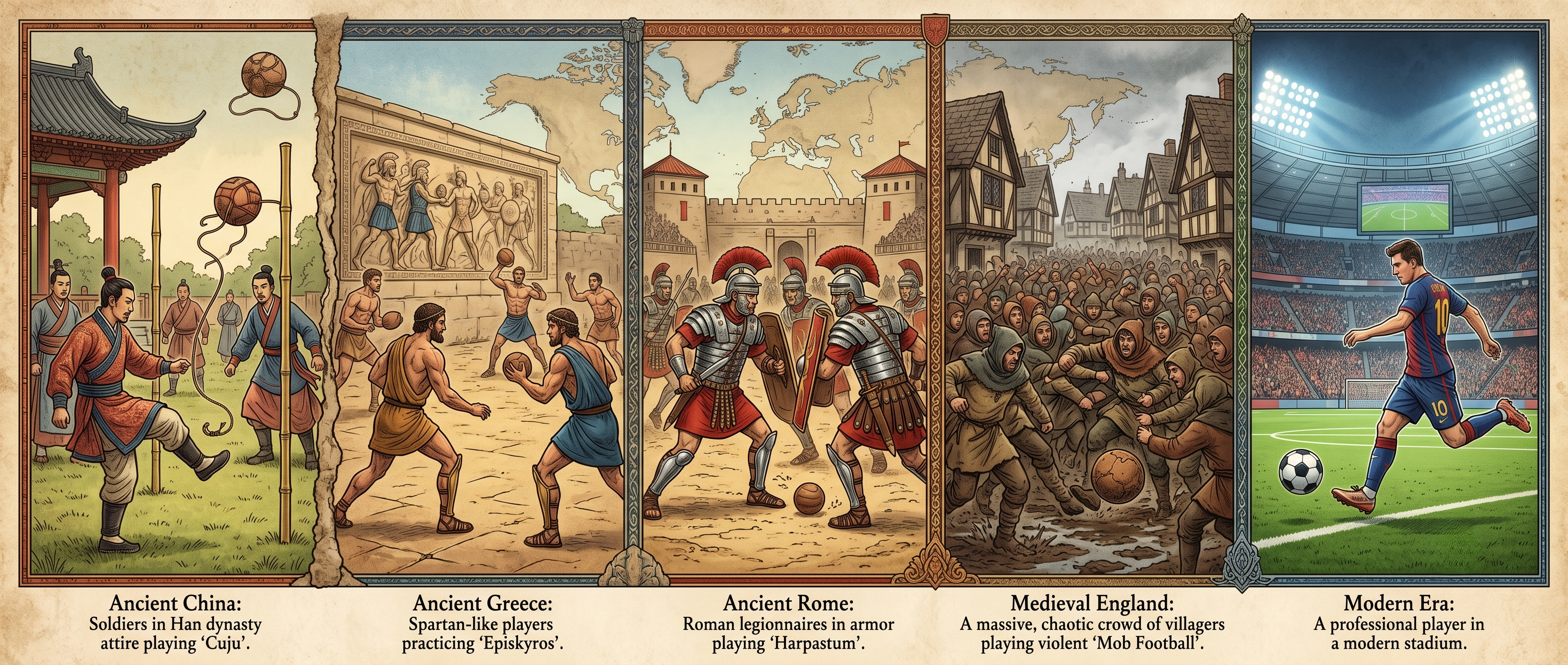
The Historical background :
Football, in its modern form, emerged in 1863 in England with the founding of the Football Association, but its origins stretch back more than 2,500 years BC to ancient China (Cuju), Greece, Rome, and medieval Britain.
In ancient China, more than 2,500 years ago (specifically in the 2nd and 3rd centuries BC), football made its first official appearance, recognized by FIFA, under the name "Cuju," meaning "kicking the ball with the foot." It appeared during the Han Dynasty as part of military training and later became a popular pastime for the nobility. It involved kicking a small ball into a net raised above the ground, with the losing team facing punishment such as flogging or food deprivation.
The Greeks renamed their game "Episkyros," a physical, team-based activity focused on passing the ball over opponents' heads to the back line, primarily for military training that emphasized strength and speed. Romans adopted it and called it "Hapastum," turning it into a structured military game with rules, played with a fixed number of players in a designated area, using both hands to intercept and score. It spread to Britain in the Middle Ages, evolving into violent "Mob Football," used to settle scores, often with injuries or deaths. Modern rules were set in 1863 in London, evolving to prioritize player safety and reduce physical dominance.
Watch the video about Quillvei Talking about Football
Beyond its historical dimensions, football carries deeper meanings. It served as an alternative to tribal warfare, particularly in medieval Britain, allowing disputes between tribes to be resolved without resorting to swords. Today, it symbolically represents a military simulation. On this battlefield, a team (representing its country's army), a coach (the commander), defensive and offensive lines, breaching enemy lines, and capturing their stronghold (represented by scoring a goal) all come to mind. This similarity has made modern football a means of satisfying the age-old human instinct for conflict and dominance, but without the need for bloodshed. When considering the instinct to fight, the cheers, and the enthusiasm, one might think of ancient arenas where warriors fought to the death, similar to modern wrestling and boxing. However, what football offers is different: teamwork versus individualism, a sense of belonging, and viewing the team as a representative of a nation rather than just itself. Furthermore, football possesses numerous elements that allow even a small, weak team to defeat a giant with a clever plan or a single counter-attack. And it avoids bloodshed and violence, which many people dislike today.

Furthermore, the support and sponsorship given to football, along with its relatively easy rules, make it more dominant than most other sports. So, my friend, before judging your husband, father, or brother for his passion for football, I think you should try watching it with him and see it from a completely different perspective. When I was little, I used to watch football with my father, and I would only support the blue team because most of my clothes were blue and it was my favorite color. I grew up a little and started to see it as a strange game, and I didn't understand why others were so passionate about it. From my point of view, it was just a group of grown men running after a ball like children. Today, when I watch football with my husband, I want it to be part of our shared activities, and for me to be part of his hobby as he is part of mine. Sometimes, when I pretend I don't care or like it, I find myself shouting enthusiastically and wanting to see the team that tries harder win. Other times, I want to see the team that everyone said had no chance of winning. Football can be an opportunity to learn about history and to know that everyone has a chance to win. Most importantly, until the last minute, until the referee blows the final whistle, we must not give up. Isn't that how life works?