A hundred years had passed, and still she waited for the moon to turn red.
She often imagined it—the color of human blood. Not the dull red of fruit or paint, but something deeper, something alive. It was the color she longed for most, especially in those small, accidental moments in the kitchen—when a knife slipped, when Glass cracked, when something sharp met her skin.
She still bled.
But what flowed from her was not red.
She prepared carefully. A grand feast stretched across her table—fruits split open, their colors spilling freely; breads, herbs, dark honey glistening like liquid night. She decorated her home with flowers and pieces of tree trunks, shaping something that resembled a celebration.
She left out the lights.
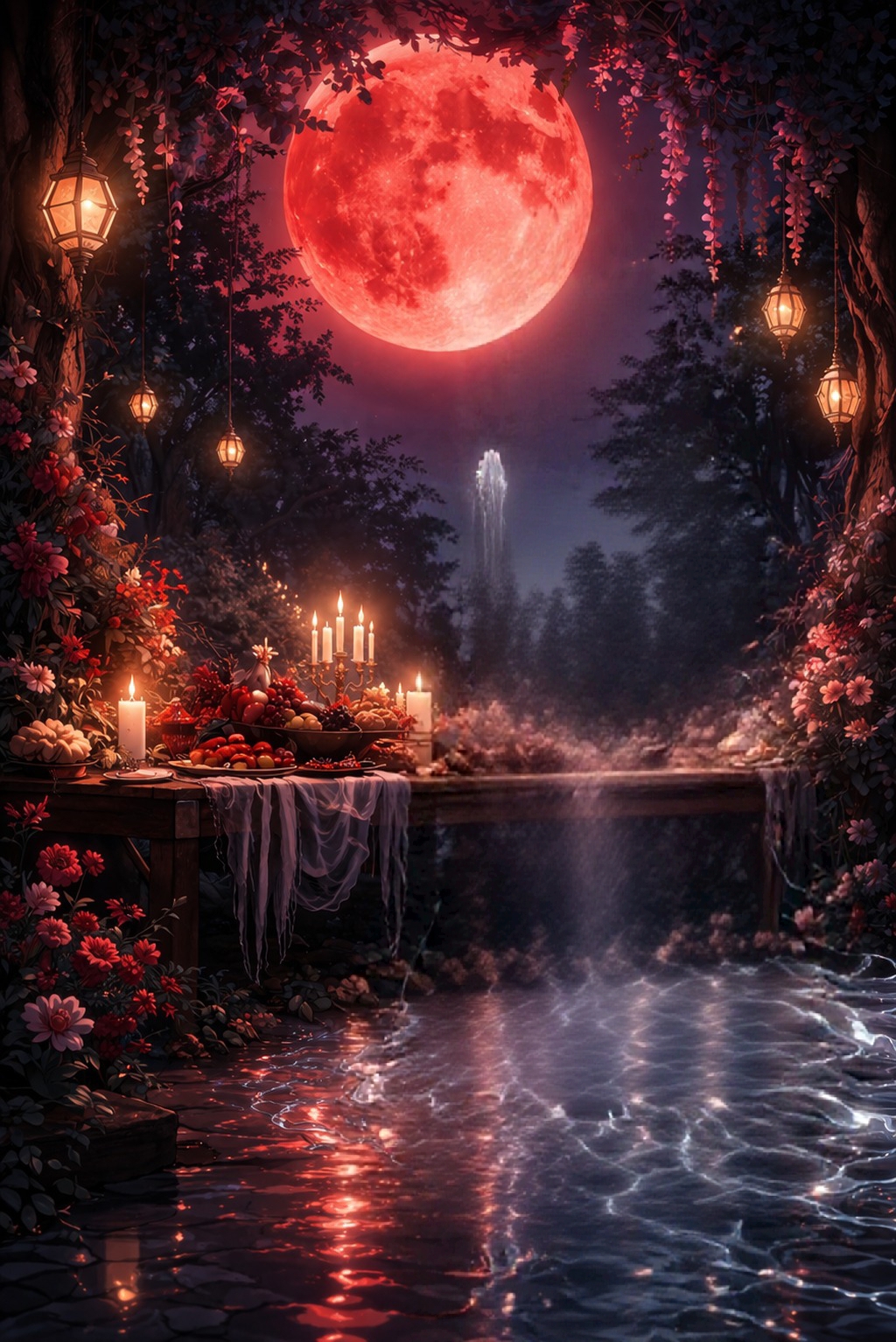
In the presence of the moon, all lights dimmed—even her own.
She waited for the others to come. She wasn’t certain they existed in the way she imagined them. But she held onto the idea of them—beings who would gather, who would witness, who would celebrate with her.
Any color would be enough—anything but clear.
It was clear—like water spilling from a broken cup, catching the colors of whatever lay around her. It shimmered, reflected, borrowed—but never became its own.
Each time, she would rush—hopeful, almost breathless—to the nearest red fruit. She would press it, watch its juice stain her fingers, and wait.
But the color never stayed; it never became hers.
She had to wait for the moon. The moon that will appear tomorrow.
This time, she believed, it would be different.
She had thought about other colors, of course.
Black, for instance.
In stories, black blood belonged to monsters, to things feared and hunted, to creatures whispered about in the dark. For a long time, she had recoiled from the idea.
.THE MOON OF COLORS STORY TEASER
The most elegant clothes were black. The quietest, most beautiful nights were wrapped in darkness. Even honey—rich, rare honey could be nearly black, and it was treasured.
If her blood turned black beneath the red moon, she would accept it as long as it was hers. As long as it told a story—one that had not yet been written, one that had not yet been read.
A story that would make her real. Opaque. Visible.
Human, in some quiet, undeniable way.
Everything in the world seemed to have color.
Flowers burned with it. Fruits overflowed with it. Even shadows held depth, variations, meaning.
Everything had color
Except water.
Except air.
And her.
She wondered if she was closer to them than she had ever wanted to admit.
Transparent things were valued, after all.
The clearer the water, the purer it was said to be. The cleaner the air, the more precious it is. Glass, diamonds—things that revealed everything and hid nothing—were admired for their clarity.
Did that make her valuable?
Had she been wrong all this time, searching for color, longing to stain herself with something opaque?
But then again.
Water could be clouded in an instant. Air could be polluted, choked, or made heavy. Glass could shatter with a single strike.
Was transparency truly purity?
Or was it fragility?
Was it beauty—or was it the absence of self?
Her thoughts spiraled, circling endlessly, deepening into something she could no longer name.
.jpg)
THE MOON OF COLORS STORY TEASER
And then
The night arrived.
The moon began to rise.
At first, it was pale, distant, untouched.
Then slowly—almost imperceptibly—it changed.
A blush.
A deepening.
A quiet, inevitable transformation.
Red.
The world dimmed in its presence. The flowers lost their brightness, the feast softened into shadow, and even she felt her faint inner glow begin to fade.
She stood still. Waiting. Watching. For the first time in a hundred years, she stopped questioning.
It no longer mattered whether transparency was purity or weakness, beauty or emptiness.
It no longer mattered what color meant.
The moon had arrived, with its color plate, promising her a new color.
It could be
Red.
Black.
Or something no one had ever seen before.
But she knew this:
Whatever flowed within her now would carry everything she had been, her waiting, her longing, her quiet, endless questions.
Her hundred years.
For the first time, she would not reflect the world around her. She would become it.